
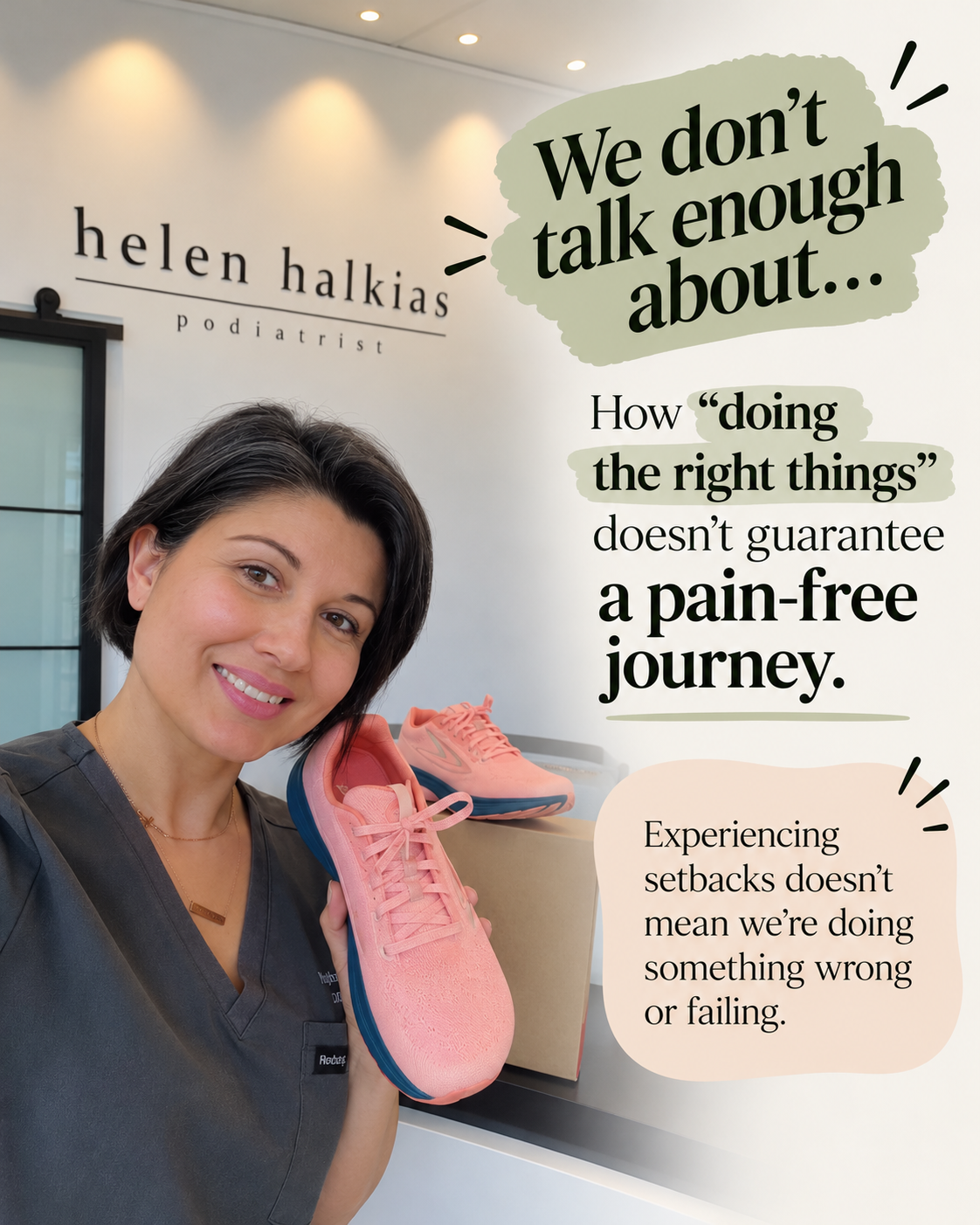
When doing all the right things isn’t enough
Something I don’t think we talk about enough is how you can be proactive about your foot health and still experience pain.
I regularly see patients in my clinic who have been wearing barefoot-style footwear for years, making conscious choices about their foot health, staying active and working on their strength and mobility, yet still develop foot pain or experience periods of discomfort.
Understandably, this can be incredibly frustrating, particularly when you’re genuinely trying to do what’s best for your feet.
You might find yourself asking:
- What am I doing wrong?
- Why am I experiencing pain when I’ve been wearing appropriate footwear?
- Should I be doing more exercises?
- Should I be doing something differently?
- Is what I’ve been doing actually working?
But experiencing pain or setbacks doesn’t necessarily mean you’ve made the wrong choices or that your previous efforts have been wasted.
Foot health is far more complex than footwear alone.
Barefoot shoes are not an insurance policy against foot pain
As a functional podiatrist, I am a strong advocate for anatomically shaped, barefoot-style footwear and encouraging our feet to move as naturally as possible, as often as possible.
I believe there is enormous value in allowing our toes the space to spread, our feet the freedom to move and our muscles the opportunity to actively contribute to movement and stability.
However, I am also the first to acknowledge that wearing barefoot shoes is not an insurance policy against ever developing foot pain.
Any more than eating a healthy, nutritious diet guarantees that you’ll never become unwell.
Good nutrition is an important part of our overall health and wellbeing, but it doesn’t exist in isolation. Our genetics, lifestyle, sleep, stress levels, physical activity and individual circumstances all influence our health.
The same principle applies to our feet.
Footwear is one important piece of the foot health puzzle, but it is not the entire picture.
Foot health is about more than footwear
Changing to more anatomically appropriate footwear can create an environment that better accommodates natural foot movement, but providing that environment and developing the physical capacity to function well within it are two different things.
Our feet need to be capable of managing the demands placed upon them.
There are many factors that contribute to this, including:
- Intrinsic and extrinsic foot muscle strength
- Big toe mobility, strength and stability
- Ankle and hip mobility
- Lower limb strength and coordination
- Balance and proprioception
- Tendon and tissue load tolerance
- Previous injuries and existing structural changes
- Activity levels and recovery
- Age, hormonal changes and general health
Simply changing our footwear does not automatically address all of these factors.
This is why I place so much emphasis on combining appropriate footwear choices with targeted exercises, movement education and gradually developing strength and functional capacity.
The ultimate goal isn’t simply to wear barefoot shoes. It’s to develop healthy, strong, functional and resilient feet.
Our bodies and circumstances change
Even if we’ve been successfully wearing barefoot footwear for years, our physical capacity is not necessarily going to remain the same throughout our lives.
Our bodies are constantly adapting to the demands of our environment, and those demands can change.
We might increase our walking distances, take up a new sport, return to exercise after a period of inactivity, spend more time standing at work or experience changes in our general health.
Equally, periods of stress, illness, poor sleep, hormonal changes or reduced physical activity may influence our ability to tolerate and recover from physical demands.
Sometimes, without even realising it, we begin asking more of our bodies than they are currently capable of managing.
There may be nothing inherently wrong with the footwear we’re wearing or the activities we’re undertaking. Rather, there may be a mismatch between the demands we’re placing on our bodies and our current capacity to tolerate them.
Recognising this is an important part of understanding why pain can develop, even when we’ve been making positive choices about our foot health.
Rehabilitation is rarely a linear process
We often expect rehabilitation to follow a relatively straightforward path.
We identify a problem, implement a treatment plan, perform our exercises consistently and expect to gradually improve until the problem resolves.
Unfortunately, rehabilitation doesn’t always work that way.
There may be periods of significant improvement, followed by periods where progress slows, symptoms fluctuate or we experience another setback.
And I think it’s important to acknowledge how incredibly frustrating this can be when you’re putting in the effort, doing what you believe are all the right things and still not getting the results you’d hoped for.
It’s easy to start questioning the plan, losing confidence or feeling discouraged.
This can be challenging for both the patient and the practitioner.
As a practitioner, I want my patients to make progress, feel better and regain confidence in their ability to move. When things don’t progress as anticipated, it is equally important for me to reflect, reassess and consider whether something needs to change.
Setbacks don’t necessarily mean that the original approach was wrong or that all the progress made has been lost.
Sometimes, they provide us with valuable information about what the body currently needs.
The ability to adapt the plan is a strength, not a failure
One of the most important aspects of rehabilitation is being willing to adapt.
Having a treatment philosophy doesn’t mean that every patient needs to follow exactly the same path or that we should continue pursuing a particular approach when it is no longer meeting their needs.
Sometimes, we need to think outside the box.
This might involve:
- Modifying the type, intensity or frequency of exercises
- Adjusting walking distances or activity levels
- Allowing more time for recovery
- Reassessing footwear choices
- Temporarily introducing taping, cushioning or other forms of support
- Addressing areas of weakness or restricted mobility elsewhere in the body
- Reassessing the original diagnosis or arranging further investigations where appropriate
- Gradually rebuilding strength and tolerance at a more achievable pace
Introducing a temporary form of support or modifying footwear doesn’t necessarily contradict the principles of functional podiatry.
There may be circumstances where reducing the immediate demands placed on a painful or irritated structure allows us to continue working towards improving its longer-term capacity.
For some individuals, ongoing support may also be appropriate.
We don’t have to keep pushing through pain or persist with an approach that isn’t working simply because we believe it is what we should be doing.
That’s not failure. That’s good rehabilitation.
Functional podiatry is not an all-or-nothing approach
I am passionate about encouraging people to develop stronger, more functional feet and, where appropriate, become less reliant on external support.
However, I don’t believe that this needs to be an all-or-nothing approach.
There is no benefit in becoming so focused on achieving a particular footwear or rehabilitation goal that we overlook what the individual in front of us actually needs.
Some people may comfortably tolerate minimal footwear, while others may require greater cushioning, protection or support, either temporarily or over a longer period.
Individual circumstances matter.
I believe that functional podiatry should be about empowering people to better understand their bodies, recognise their current capabilities and work towards improving their function in a way that is appropriate, achievable and sustainable.
It’s about meeting people where they are, rather than expecting everyone to fit into the same model of foot health.
Building resilience rather than expecting perfection
Being proactive about our foot health is worthwhile, even if it doesn’t guarantee that we’ll never experience pain or injury.
We exercise to improve our strength and general health, not because exercise guarantees that we’ll never become injured.
We eat nutritious food to support our wellbeing, not because it guarantees that we’ll never become unwell.
Similarly, we can make conscious footwear choices, work on our strength and mobility and develop better movement habits without expecting a completely pain-free journey.
The aim is to build capacity, improve function and give our bodies the opportunity to become more resilient.
And when setbacks do occur, we can use them as an opportunity to better understand our bodies and make informed decisions about what we need to do next.
Persistent, worsening or recurrent foot pain deserves appropriate assessment, rather than simply assuming that more exercises or a change in footwear will resolve it.
The goal hasn’t changed
If you’re experiencing foot pain despite making positive changes to your footwear, working on your strength and mobility or following a rehabilitation program, it doesn’t necessarily mean that your efforts have been wasted.
It may simply mean that it’s time to reassess the plan.
The challenge is to maintain confidence in the process while recognising when something needs to change.
For me, the fundamental goal of functional podiatry remains the same:
Better alignment. Greater strength. Improved function.
How we work towards that goal may look different from one individual to another, and it may change at different stages of the rehabilitation journey.
The goal hasn’t changed. We’re simply finding a more appropriate, achievable and sustainable way forward.
Because sometimes, the ability to pivot, adapt and keep moving forward is where real progress begins.
One achievable step at a time. 💚
Helen Halkias – Podiatrist
Functional Podiatry | Blackburn, Melbourne