
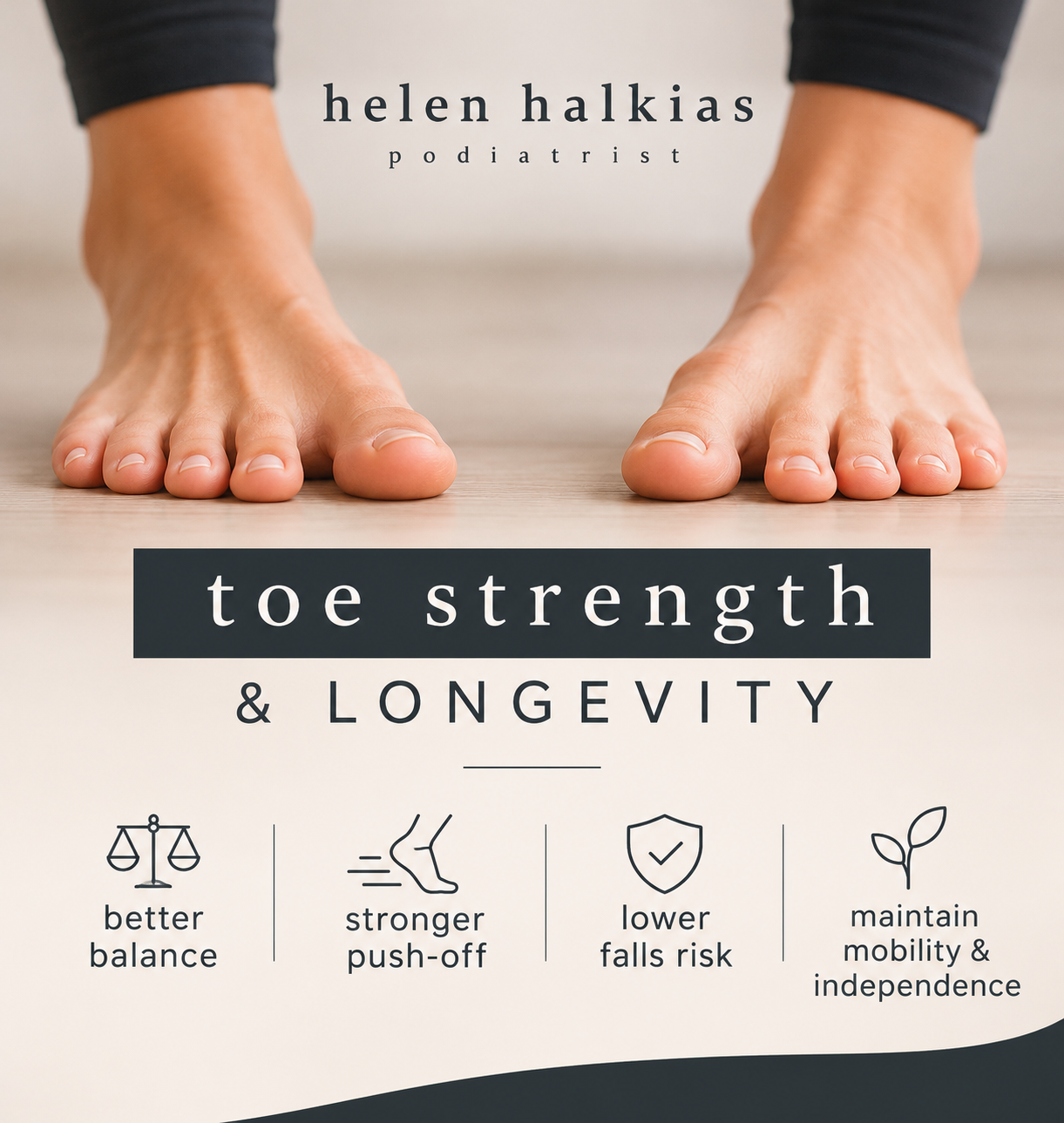
When we think about maintaining strength as we age, we often focus on our legs, glutes and core. But there’s one area that rarely gets the attention it deserves — our toes!
As a functional podiatrist, I’m really passionate about the importance of natural toe positioning, keeping our big toes facing forward and allowing enough space for our toes to spread naturally.
But something equally important is toe strength.
Our toes play a much bigger role in how we balance, walk, run and maintain our mobility than many people realise. And research is increasingly highlighting just how important toe strength can be as we age.
Toe Strength, Balance and Falls Risk
One of the most interesting areas of research is the relationship between toe strength and falls risk.
A study by Mickle and colleagues (2009), involving 312 older adults, found that those who experienced falls had significantly weaker big-toe and lesser-toe strength than those who didn’t fall.
More recent research published in 2026 also found that toe strength was more strongly associated with falls than knee extension or handgrip strength in the older adults studied.
These findings highlight an often-overlooked aspect of balance and stability.
Our toes help us respond to changes in body position, maintain contact with the ground and control our centre of mass as we move.
Although toe strength is only one part of the balance equation, it’s an important part that deserves more attention.
Toe Strength and Propulsion: The Importance of Push-Off
Our toes don’t just help us balance. They also play an important role in moving us forward.
During walking and running, our body weight moves across the foot towards the forefoot as we prepare to push off the ground.
The toes, particularly the big toe, help provide a stable platform for this process.
The muscles controlling our toes contribute to force production, forefoot stability and the transfer of load through the foot during propulsion.
When we have good toe alignment, mobility and strength, we’re better equipped to use our feet effectively throughout the gait cycle.
This is why I place so much emphasis on keeping our big toes aligned forward, allowing our toes to spread naturally and developing the strength to control them.
Toe positioning and toe strength go hand in hand.
Toe Strength and Longevity
When I talk about longevity, I’m not simply referring to living longer.
I’m talking about maintaining the strength, mobility, balance and independence to continue doing the things we enjoy as we get older.
Falls are a major concern as we age, particularly because they can lead to injury, reduced confidence and loss of independence.
Research has identified reduced toe strength as a factor associated with increased falls risk.
This doesn’t mean that stronger toes alone will prevent falls or directly increase lifespan. However, maintaining foot strength and function is one valuable component of healthy ageing.
Strong, functional feet help provide the foundations for lifelong movement.
How to Start Strengthening Your Toes
The good news is that our toe muscles can be trained, just like other muscles in the body.
And you don’t need any fancy equipment to get started!
One of my favourite exercises is a simple standing movement that encourages your toes to work against your own body weight.
Step 1: Stand Barefoot
Stand comfortably on a firm, level surface with your feet approximately hip-width apart.
Step 2: Position Your Toes
Keep your toes long, flat and naturally splayed.
Pay particular attention to your big toes, encouraging them to point straight forward rather than drifting towards the lesser toes.
Step 3: Engage Your Foot Tripod
Establish three points of contact with the ground:
- Your heel
- The base of your big toe
- The base of your little toe
These three points form your foot tripod, providing a stable foundation for movement.
Step 4: Shift Your Body Weight Forward
Keeping your body relatively straight, slowly lean forward from your ankles, allowing your body weight to move towards the front of your feet.
Keep your heels grounded.
As you begin to feel your weight shifting forward, actively press your toes long and flat into the ground to resist tipping forward.
Your toes should be working to help control your body position.
Step 5: Return and Repeat
Slowly return to your starting position.
Repeat several times, focusing on maintaining your toe alignment and controlling the movement.
Start with a small forward lean and gradually increase the challenge as your strength and control improve. Stand near a stable bench for support if your balance is uncertain.
The Key: Press, Don’t Grip!
This is something I really want to emphasise.
Toe strengthening isn’t simply about curling, clawing or gripping the ground.
We want to develop the ability to generate force through toes that remain long, aligned and in contact with the ground.
Think about pressing your toes down rather than scrunching them up.
The aim is to develop functional strength that contributes to balance, stability and movement.
And remember, this is just one exercise. A comprehensive foot-strengthening programme may also include toe yoga, intrinsic foot muscle exercises, progressive calf raises and balance training.
Strong Toes, Strong Foundations
Our feet are our connection to the ground, and our toes are an important part of that connection.
Whether we’re walking, running, exercising or simply maintaining our balance, toe strength contributes to how effectively our feet function.
I encourage everyone to pay more attention to their toes — not just how they’re positioned, but how well they’re working.
Because maintaining strength as we age should include the muscles right at the ends of our feet!
Better alignment. Greater strength. Improved function.
Research References
- Mickle KJ, Munro BJ, Lord SR, Menz HB, Steele JR. (2009). Toe weakness and deformity increase the risk of falls in older people. Clinical Biomechanics, 24(10), 787–791.
- Toe Grip Strength Shows Stronger Associations with Falls than Knee Extension or Hand Grip in Older Adults. (2026). PubMed.
- Jaffri AH et al. (2023). Evidence for Intrinsic Foot Muscle Training in Improving Foot Function: A Systematic Review and Meta-Analysis. Journal of Athletic Training.
Research note: Studies of toe strength commonly measure toe flexor or toe grip force. This is a measurement method, not an instruction to curl or claw the toes during exercise.