
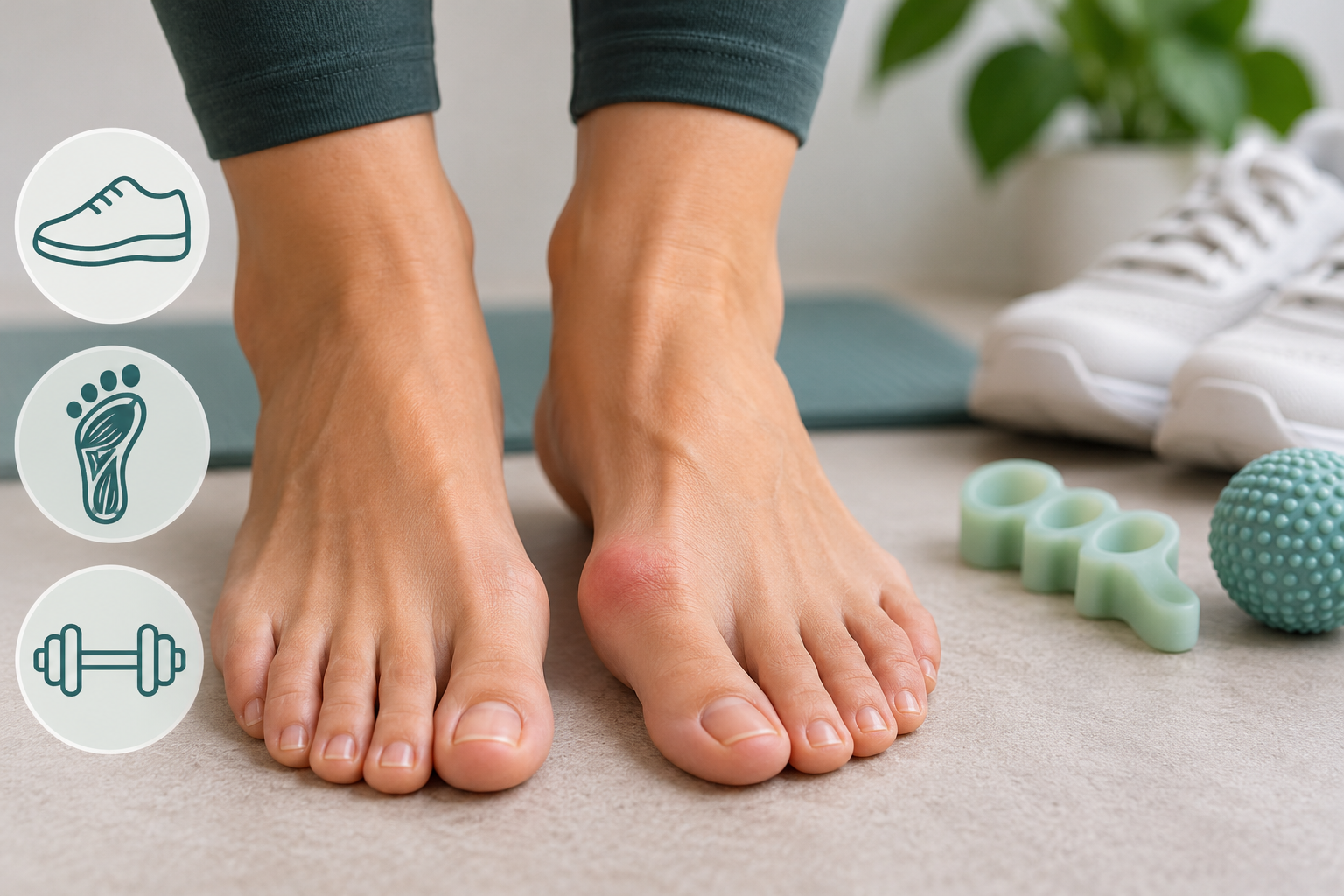
One of the most common foot conditions I see in my podiatry clinic is bunions, and many patients seek advice about what can be done to manage them.
There is often an assumption that once a bunion develops, there is very little that can be done other than accommodate it with footwear or eventually have surgery.
But having a bunion doesn’t automatically mean surgery is your only option.
Whilst we may not be able to reverse established structural changes, there is often plenty we can do to improve muscular control, strength, stability and the capacity of our feet to tolerate load.
The key is understanding where you are starting from, what your individual foot is capable of and how we can build upon that capacity.
Understanding what a bunion actually is
A bunion, medically known as hallux valgus, is much more than just a bony prominence on the inside of the foot.
It is a complex structural deformity involving changes in the alignment of the first metatarsal and the big toe. Over time, there may also be changes to the bone itself, the joint surfaces and the articular cartilage, with some individuals developing degenerative or arthritic changes.
However, the structural changes are only part of the picture.
There are also changes in the surrounding soft tissues, including the muscles, tendons, ligaments and joint capsule. These can influence the stability, mobility and functional capacity of the foot.
As the alignment of the big toe changes, so too can the mechanical advantage and effectiveness of the muscles responsible for controlling it.
In clinical practice, I often see bunions in feet with a particularly flexible or unstable forefoot, reduced intrinsic muscle control and difficulty maintaining stability under load.
Factors that may contribute to the development or functional presentation of a bunion include:
- Genetics and inherited foot structure
- Joint laxity and hypermobility
- Forefoot instability
- Muscle weakness and soft-tissue imbalances
- Restrictive or poorly fitting footwear
- Reduced foot and ankle mobility
- Altered loading patterns during standing and walking
Bunions are multifactorial, and not every person develops one for the same reasons.
We may not be able to change the structure entirely, but that doesn’t mean we can’t improve the function.
Not all bunions are the same
Bunions vary considerably in their severity, flexibility and associated structural changes.
Some individuals have a relatively flexible deformity, where the big toe can still be repositioned and there is considerable movement available through the joint.
Others have a more established, rigid deformity, where the big toe can no longer be easily repositioned. Associated degenerative changes may also result in very little available joint movement.
The severity of the deformity, its flexibility and the mobility of the big toe joint are not necessarily the same thing. Each needs to be assessed individually.
A functional podiatry assessment can help determine:
- The severity and flexibility of the deformity.
- Whether the big toe can be actively or passively repositioned.
- How much movement is available through the joint.
- Whether restrictions relate to soft tissues, structural changes or joint degeneration.
- How effectively the muscles of the foot are functioning.
- How well the foot and lower limb maintain stability under load.
- Whether further investigations, such as weight-bearing X-rays, are appropriate.
This allows us to establish realistic goals and develop an individualised management programme that respects the structural limitations of the foot whilst working towards improving its functional capacity.
What if I have a rigid bunion and can’t move my big toe?
That doesn’t necessarily mean there is nothing you can do.
Even when the big toe joint has very limited movement, there may still be opportunities to improve muscular control throughout the foot, strengthen the surrounding musculature, improve balance and stability, and address other contributing factors throughout the lower limb.
We don’t necessarily need to restore movement to a rigid joint to improve the overall function of the foot.
Sometimes, improving how the foot manages load within its existing structural limitations is a more appropriate goal than trying to achieve movement that is no longer available.
Rather than focusing solely on what your foot can no longer do, I encourage you to explore what it is still capable of doing — and how we can build on that.
Why is big toe function so important?
Our big toes contribute to balance, stability, propulsion and the transfer of body weight through the foot during walking and running.
The base of the big toe also forms part of what we refer to as the foot tripod — three important points of contact between the foot and the ground:
- The heel
- The base of the big toe
- The base of the little toe
Together, these points provide a foundation from which we can create stability and generate movement.
When big toe alignment, mobility or strength is compromised, it can affect how we load the foot and potentially contribute to compensatory movement patterns elsewhere.
However, the big toe is only one component of a much larger functional system. Even when its function is limited, there is still value in developing the capacity of the remainder of the foot and lower limb.
Six ways to improve foot function when you have bunions
Not every exercise or intervention will be appropriate for every individual. The following strategies should be adapted to suit your particular foot structure, symptoms and functional capacity.
1. Give your toes room to move
Many conventional shoes have a tapered toe box that compresses the toes together rather than allowing them to sit in their natural position.
Look at the shape of your bare foot and then look at the shape of your shoe. Do they look anything alike?
Choosing footwear with a wide, anatomically foot-shaped toe box allows the toes more room to spread, move and contribute to stability where movement is available. It can also reduce direct pressure and irritation around the bunion.
For someone with a rigid deformity, accommodating the existing foot shape is particularly important. Other footwear features, such as cushioning, sole stiffness or a rocker sole, may also be beneficial depending on joint mobility and symptoms.
There is no single footwear style that is appropriate for everyone with a bunion.
Changing footwear is an important consideration, but wherever possible, we also want to improve the capacity of the foot to function within that footwear.
2. Maintain and improve available big toe mobility
Maintaining movement through the big toe joint, where possible, is important for efficient walking and overall foot function.
Appropriate exercises may include:
- Gentle big toe joint mobilisation.
- Controlled big toe extension.
- Using a small block or wedge to introduce big toe extension during exercise.
- Practising independent big toe movements.
- Developing active control within the available range.
The aim is not to force the joint into a particular position but to work within a comfortable, available range of movement.
Restrictions may be related to soft tissues, structural changes or joint degeneration. Forcing movement through a significantly restricted or rigid joint may aggravate symptoms.
In these circumstances, our focus may shift towards strengthening, stability and improving load management within the foot’s existing capacity.
3. Strengthen the muscles of your feet
Our feet contain numerous small muscles that contribute to stability, movement and control, yet we often spend very little time actively strengthening them.
This is an area I believe is worth exploring regardless of the severity of your bunion.
Even if big toe alignment cannot be significantly improved, developing better muscular control throughout the foot may still be beneficial.
Appropriate exercises may include:
- Toe spreading, also known as toe splay.
- Toe yoga and independent toe movements.
- Short foot exercises to improve intrinsic muscle control.
- Single-leg balance exercises.
- Controlled calf raises with attention to foot and toe alignment.
- Toe strengthening without excessive curling or gripping.
A simple exercise to get you started
Stand barefoot with your toes as long, flat and comfortably spread as your foot allows.
Maintain contact through your foot tripod and gently shift your body weight forward whilst keeping your heels on the ground.
Use your toes to resist that forward movement by pressing them long and flat into the ground rather than curling or gripping.
Have a stable support nearby if needed and work within a comfortable range.
This is a simple way to begin developing awareness, strength and active muscular control.
If your big toe is rigid or cannot be repositioned, the exercise may need to be adapted. You do not need perfect toe alignment to begin working on muscular control.
4. Consider using toe spacers
Toe spacers can be a useful addition to conservative bunion management, particularly where the deformity remains relatively flexible.
They may help improve toe positioning whilst being worn, reduce pressure between the toes and provide feedback about toe alignment.
I encourage patients to think of toe spacers as a tool rather than a treatment in isolation.
Where appropriate, combining them with active foot exercises may help develop awareness, muscular recruitment and control.
However, toe spacers are not appropriate for everyone. Forcing a rigid big toe into a straighter position may create unnecessary pressure or discomfort.
The aim is to work with your foot, not against it.
5. Look beyond the bunion
Your feet do not work in isolation.
What happens at the ankle, knee and hip can influence how you load and move through your feet.
A functional assessment may also include:
- Ankle mobility
- Calf strength and endurance
- Hip mobility
- Gluteal strength
- Single-leg stability
- Walking and movement patterns
- Overall lower-limb strength and coordination
Restricted ankle mobility may alter how we move over the foot during walking, whilst reduced hip control can influence lower-limb alignment and loading.
This becomes particularly relevant when established structural changes within the foot cannot be reversed.
We may not be able to restore movement to a rigid big toe joint, but we may be able to improve other aspects of movement, stability and strength throughout the lower limb.
6. Focus on function, not just appearance
The appearance of your feet does not necessarily determine how well they can function.
Some people have prominent bunions and experience very little discomfort. Others have relatively mild structural changes but experience considerable pain or difficulty with movement.
Our goal should not always be to achieve a perfectly straight big toe.
Instead, we can work towards:
- Greater foot strength and stability.
- Better balance and muscular control.
- Maintaining available joint mobility.
- Reducing discomfort and footwear irritation.
- Improving tolerance to everyday activities.
- Maintaining an active lifestyle.
For one person, improvement may mean developing better big toe control. For another, it may mean feeling more stable, walking more comfortably or improving confidence during everyday activities.
Both are equally worthwhile goals.
You do not need to have perfect-looking feet to have strong, capable and functional feet.
Can you reverse a bunion without surgery?
Whilst conservative management may improve muscular control, available mobility, comfort and, in some cases, toe positioning, it is unlikely to completely reverse an established structural bunion.
The bony alignment, joint surfaces, cartilage and surrounding soft tissues may have undergone significant changes over time.
It is important to distinguish between structural correction and functional improvement and to have realistic expectations about what conservative management can achieve.
Earlier intervention may provide more opportunities to address contributing factors and support foot function. However, even if you have had bunions for many years, it is still worth exploring your remaining functional capacity.
Surgery certainly has its place, and for some individuals it may be the most appropriate treatment option.
However, even if surgery is ultimately required, there may be value in optimising foot function beforehand.
We often hear about rehabilitation following surgery, but what about prehabilitation?
Where appropriate, working on foot strength, available joint mobility, ankle function, balance and lower-limb control before surgery may help prepare the body for rehabilitation.
Surgery can address structural alignment and, depending on the procedure, associated joint pathology, whilst rehabilitation helps develop strength, movement control and functional capacity following surgery.
Conservative management and surgical intervention do not need to be viewed as opposing approaches. They can complement one another.